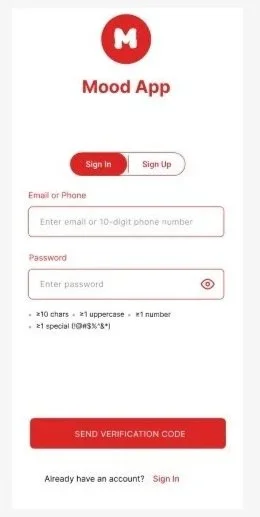
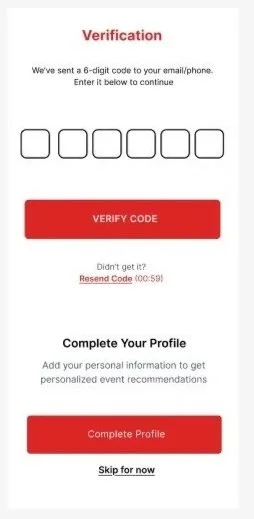
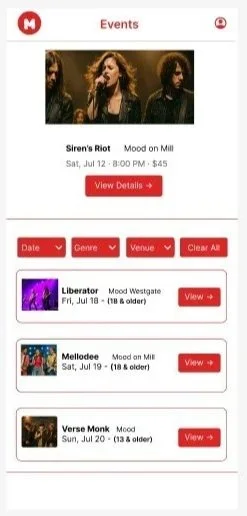
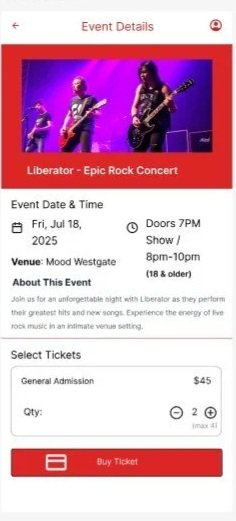
Problem Statement & Context: This project focused on designing and prototyping four complete, end-to-end user flows for a mobile ticketing app serving three local music venues. Rather than showcasing isolated screens, the goal was to demonstrate how users actually move through the app—step by step—from account creation through event discovery, ticket purchase, and ticket access.
I approached this project by first mapping every screen required for each flow to ensure nothing was skipped or implied. The prototype intentionally shows before-and-after states for key interactions, such as filtering events, adjusting ticket quantities, and verifying account information. This allowed stakeholders to experience the product as a real user would, rather than as a static slideshow of screens.
Outcome: The prototype was designed to be fully clickable and presentation-ready, supporting a live walkthrough for stakeholders. Only screens and interactions required by the four defined flows were included, keeping the experience focused while clearly illustrating how the app’s features work together. Visual content—band imagery, event thumbnails, and ticket graphics—was used throughout to reflect a realistic, high-fidelity product and communicate the future of the venues’ business.
Because no brand system or style guide was provided, I established a cohesive visual language through color, typography, and iconography that supports readability, hierarchy, and quick decision-making in a mobile context. Design choices prioritized clarity, confidence, and ease of use, especially in moments that matter most—sign-up, checkout, and ticket access at the venue.
Reflection
Reflection: This project reinforced the importance of designing for clarity and efficiency in mobile environments. It demonstrated how thoughtful navigation, hierarchy, and spacing can significantly reduce friction and improve user confidence. Through testing and iteration, I saw how small refinements can meaningfully impact usability and task completion speed.
Overall, the project strengthened my skills in UX research, mobile interface design, high-fidelity prototyping, and user-centered iteration—while highlighting how strong design decisions can support both business goals and user needs.